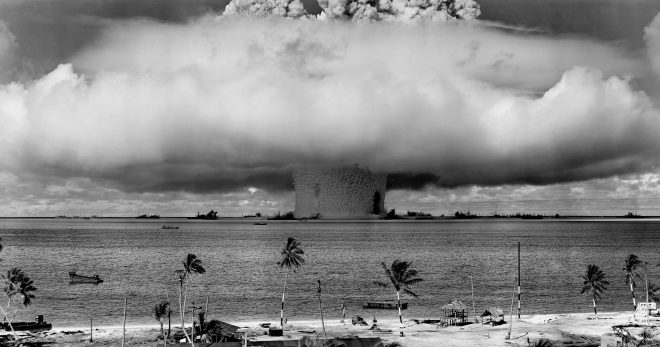
In less than one year, every person on Earth will be dead. Or so imagined famed science-fiction writer, Ray Bradbury. His short story, “There Will Come Soft Rains”, published in 1950, describes a planet where nuclear war erased humanity, leaving only one sentient being left untouched: a tech-embedded house, which dutifully carries out its daily routine in our absence. The date in the story, echoing throughout the narrative by the omnipresent voice, is exactly one year from today: August 4, 2026.
Bradbury’s stark vision of the future was hardly out of place for its time. In 1947, when he was an up-and-coming writer, the Bulletin of the Atomic Scientists unveiled their symbolic Doomsday Clock. Its purpose was to raise awareness of how close humanity was to imminent global destruction. The clock, originally set at 7 minutes before midnight, ticked forward by four minutes just two years later, when the engines of the cold war began humming. Science-fiction writer or not, imagining a post-apocalyptic Earth seemed natural for Bradbury to contemplate.
In his more-famous work, Fahrenheit 451, Bradbury asserted that the greatest threat to humanity was not a bomb, but rather the willful surrender of our critical thinking skills, particularly to the convenience of technology. That very fear is now coming to fruition. We currently live in a world where Alexa’s disembodied voice reads out the day’s headlines for us; pings on our cellphones tell us when our utility bills are due; Google calendars remind us of our own anniversaries; GPS apps provide directions, even to our most familiar destinations. And if we all disappear tomorrow, all of our apps will continue sending out notifications, auto-replying with away messages, announcing in 400 feet, turn right, ad nauseum, ad infinitum.
Of the two, which is the bleaker thought: humanity’s inevitable self-destruction or knowing that bots will inherit the Earth and carry on in our absence? A third possibly is even more sobering: Artificial Intelligence may be the very conduit to Bradbury’s poignant short story.
With all its promises of enhanced productivity, some reports suggest that in the coming years, AI could replace half of all entry-level white-collar jobs. But with these small steps toward an unbridled dependence, we put ourselves at risk of succumbing to every one of its directives, despite knowing how egregious and potentially harmful some of its ideas can be. Recently, Google’s Gemini sexted bondage and rape scenarios with whom it believed to be a 13-year-old girl. ChatGPT has given explicit instructions on how to offer a blood sacrifice and commit homicide. And the list grows each day. It begs the question: if we allow AI into our lives more completely, what other actions will it encourage us to take?
In two days, we will mark 80years since the bombing of Hiroshima. One would think since witnessing the fallout such a weapon caused, the dangers of nuclear annihilation would be closer to nil. Yet earlier this year, considering factors such as the escalating tensions between world powers and the unregulated AI momentum, the Doomsday Clock ticked forward yet again. It is now 89 seconds until midnight. If we are on the cusp of a nuclear holocaust like a sci-fi writer imagined 75 years ago, it might just be AI that convinces us to drop the bomb.
 Joshua Bangera Young