“Two possibilities exist: either we are alone in the Universe, or we are not. Both are equally terrifying.”
– Arthur C. Clarke
Let’s consider for a moment that aliens exist. Consider too that those aliens are equal to or more intelligent than humans. If those two premises are true, then why have they not contacted us here on Earth? This, in a nutshell, is Fermi’s Paradox.
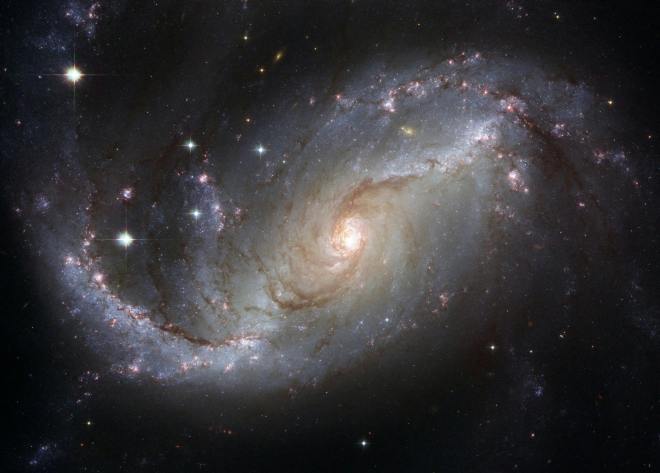
To unpack this thought experiment, it helps to first consider the sheer vastness of our universe. In a modest estimate, the Milky Way galaxy contains 100 billion stars. Consider too that there are around 2 trillion galaxies in the night sky. So, using the law of averages and applying basic multiplication, we can conclude there are roughly 1 septillion stars in the observable universe.
1 septillion stars. That’s a 1 followed by 24 zeros, or 1,000,000,000,000,000,000,000,000.
From that number, consider how many of those stars have planets, and how many of those planets have conditions capable of sustaining life. This line of thinking is the basis of the Drake equation, which when explored in full, far exceeds the perimeters of this article. But still, it is worth contemplating that somewhere deep in the cosmos, some other intelligent being is, at this moment, contemplating the possibility of our existence.
In April of 2025, the James Webb telescope discovered a planet, now dubbed K2-18b that contains biosignatures of hydrogen, methane, and carbon dioxide – elements abundant here on Earth. That planet though is 124 light years away. So, if aliens exist on K2-18b, and if we sent out a communication right now, it would arrive on their planet in the year 2149. Then, if that alien species could decode our message and send a reply, we could expect their response no earlier than the year 2273. That’s 248 years (roughly the same time between the Revolutionary War and the present day) for just one back-and-forth “hello.”
Becoming intergalactic pen-pals with aliens on K2-18b—if they exist in the first place—is impractical with our current technologies. Yet the fact remains: there is a planet within our galaxy with conditions that could sustain life. This discovery leads one back to the Fermi Paradox. If intelligent life exists over there, why haven’t they contacted us over here?
A solution, outlined by Chinese science-fiction writer Cixin Liu, is called the Dark Forest Theory. It goes something like this: think of the universe as a dark forest inhabited by hunters armed with loaded rifles, ready to kill anything that moves. To ensure their own survival, the hunters remain as quiet and as still as possible. Carrying this analogy one step further, Liu compares Earth to a little kid who builds a bonfire in that dark forest and begins shouting “Over here! Over here!”
If there is a chance the Dark Forest Theory holds even a grain of truth, perhaps we should rethink our insistence on interplanetary communication. If aliens exist, and if they are a superintelligent species, then they understand—perhaps more than we do—that where there is life, there is a pecking order, an innate desire to exert supremacy over other beings. And in their silence, those aliens have chosen peace instead of risking intergalactic war.
Maybe life exists on K2-18b. Maybe it does not. Maybe life exists somewhere else in the cosmos. Maybe it does not. Either way, in the dark forest of the universe, it may be wise to keep our voices down. We never know who might be listening.
 Joshua Bangera Young