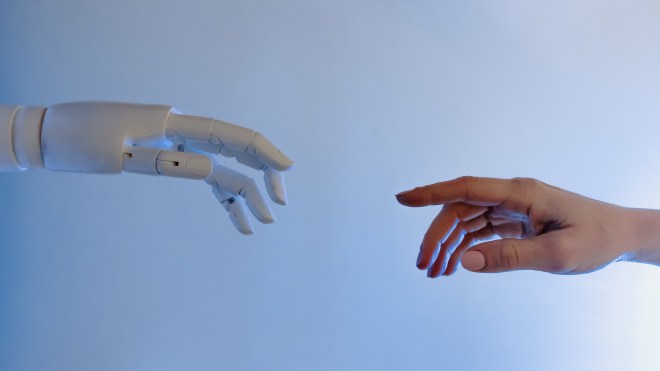
Have you ever noticed that the Terminator, the T-800 model specifically, has an entire metal endoskeleton, complete with ball-and-socket joints, a skull, upper vertebrae, and a full set of teeth? Yes, that’s right. Teeth. Why in the world would a terminator need teeth?
The ball-and-socket joints like shoulders and hips are an obvious choice for its design. They offer flexibility and optimized motion. The skull is imperative as well. It houses the CPU and gives directives through spinal connections to the rest of the machine (i.e. body). These elements of the T-800 are humanoid, sure, but they follow a logical and functional blueprint. If one were to cover the T-800 in a layer of skin, give it cool sunglasses, and teach it some slang, it would be able to blend in with a crowd of humans. Well, sort of.
But why teeth? At first, I thought it was for linguistic purposes. Humans use their lips, tongue, and teeth to create interdental and labiodental phonemes, like /f/, /l/, /v/, /th/. But it is not necessary for a machine to have such features. Their creator can simply make a voice box or a no-nonsense mouth for the robot to produce sound. Think of the character Rosy from The Jetsons or Hal from 2001: A Space Odyssey. So why, for a franchise spanning over 30 years, have its creators continued to give the machine incisors, bicuspids, and molars? Surely it wasn’t just to show off that menacing, skinless smile.
The terminator has teeth simply because it was designed by people. And people have teeth. That’s it. Plain and simple. Writers and storytellers of science-fiction design their worlds and the characters within them with our world and our bodies as templates. So even though the T-800 will never eat a steak or be subjected to a root canal, it has teeth because its creators have teeth.
The T-800 is not an exemption, but a rule. Humans impose their own traits onto their creations all the time, especially when it comes to Artificial Intelligence. Consider Atlas, the humanoid robot designed by Boston Dynamics. It has fully functional knees, hips, and shoulders—all human features, all crucial for movement and dexterity. Yet it uses this mobility to show off its parkour skills—360-spins, tumbles, and backflips. Also, consider Ameca, the AI who once drew the likeness of a cat and afterward became defensive when her audience didn’t appreciate her work. Ameca is equipped with eyelids, nostrils, earlobes, and fingernails, but does not need to blink, cannot smell, and will not be due for a manicure anytime soon. These human traits embedded into these machines mimic their creators, though they were added for aesthetics and entertainment rather than functionality. Just like putting teeth in a terminator’s mouth.
Even when storytellers do not use humanoid AI, they still incorporate human characteristics into their programming. Think of the bot TARS from the movie Interstellar, which has mechanical appendages and sockets, but not a complete human form. No teeth or earlobes on this one. It does, though, have a ‘truth’ setting, which is programmed at a modest 90%. When asked why the machine isn’t always honest, TARS quips: “Absolute honesty isn’t always the most diplomatic, nor the safest form of communication…” Failing to be truthful all the time is indeed a human characteristic, and just as naturally occurring in people as eyelids and fingernails.
Many other abstract human traits are found in Hollywood’s interpretation of AI. In the film Ex Machina, a female robot learns to manipulate and control the opposite sex; The Matrix depicts powerful machines that learn to enslave and brainwash; characters in Westworld hold grudges and seek revenge; in the movie Her, machines discover that logic and reasoning overpower love and companionship. The full extent of these examples is too vast to list here. But you get the idea.
I don’t normally quote religious texts, but if an article ever needed context, this is it. Look back at Genesis 1:27, which states: “God created man in His own image.” This is true of all gods, all creators. Even humans. When people create worlds, characters, or even artificial intelligence, they do so in their own likeness. They give their creations their own features. Even shortcomings like spitefulness and jealousy, or simple anatomy like nostrils and teeth.
AI-Created Content
So, what happens when AI, a human-created intelligence, invents something on its own? Has AI developed enough of its own being, its own self, to imprint its traits on its creations? The last two years have seen a substantial uptick in AI-generated content. Some of which is hog wash, other bits will leave you scratching your head.
Take for example, The Safe Zone, a short film written and directed by ChatGPT in 2022. The plot is rather simple: three family members anxiously watch the news on their TV, as commenters announce an AI uprising that will spell doom for humanity. The three people discuss, quite emphatically, which one of them should save themselves by going to ‘the safe zone’— a real life panic room to wait out the AI apocalypse.
The short film lacks significant plot development, but it does dabble in high-frequency movie tropes. Each of the three characters, for example, has a singular, distinct feature: “I’m the strong one;” “I’m the smart one;” “I’m the resourceful one” (actual lines of dialogue, by the way). Also, there are references to pop culture and current events that seem a bit forced (e.g., their parents met at a BTS concert and Elon Musk just purchased The Safe Zone). But there is something odd and a bit unsettling about this film. The plot, again written by ChatGPT, is about the end of the world as Artificial Intelligence takes over. Perhaps ChatGPT was being a little cheeky, since it created the storyline after sifting through online data about AI skepticism, fears of a robot uprising, or maybe just reruns of The Terminator series. The alternative—Artificial Intelligence revealing its true motive under the guise of a movie script—would be enough to motivate anyone to permanently unplug their electronics.
Another AI-generated movie, Last Stand, has a similar construct. A simple plot (aliens invade Earth, creating a space race to make first contact), pop culture references (Donald Trump is seen golfing in a MAGA hat and refers to President Biden as “Sleepy Joe”), and current events (escalating tensions between The U.S. and Russia). Again, we see a regurgitation of simple motifs in AI storytelling, but not much else. There is no rich dialogue, no character backstories, just a bare-bones plot about the end of humanity. It leaves one to think: are these films premonitions based on data inputs and logical outcomes, or are they just a mere feedback loop, a satire about humanity’s fears and insecurities?
The Turing Test
With the rise of AI, CAPTCHA (Completely Automated Public Turing test to tell Computers and Humans Apart) has become a fundamental online tool that helps websites tell the difference between real humans and malicious bots. Though, a few of these oversimplified tests, like those annoying checkboxes, do not work how one might suppose. After all, if humans can create a machine that can draw a cat, do a backflip, or write a 10-minute screenplay, it can most certainly click a checkbox. The reCAPTCHA test, though, does not measure whether one can check a box, but rather it is measuring (among other things) our close inspection, our hesitation, and how we move the mouse cursor on the screen.
Try it yourself. Consider the (non-clickable) screenshot of the reCAPTCHA check box below. Move your mouse to any corner of your screen to start. Then, move the cursor to the checkbox as you would normally do. Try it as many times as you wish, using different starting points on your screen.
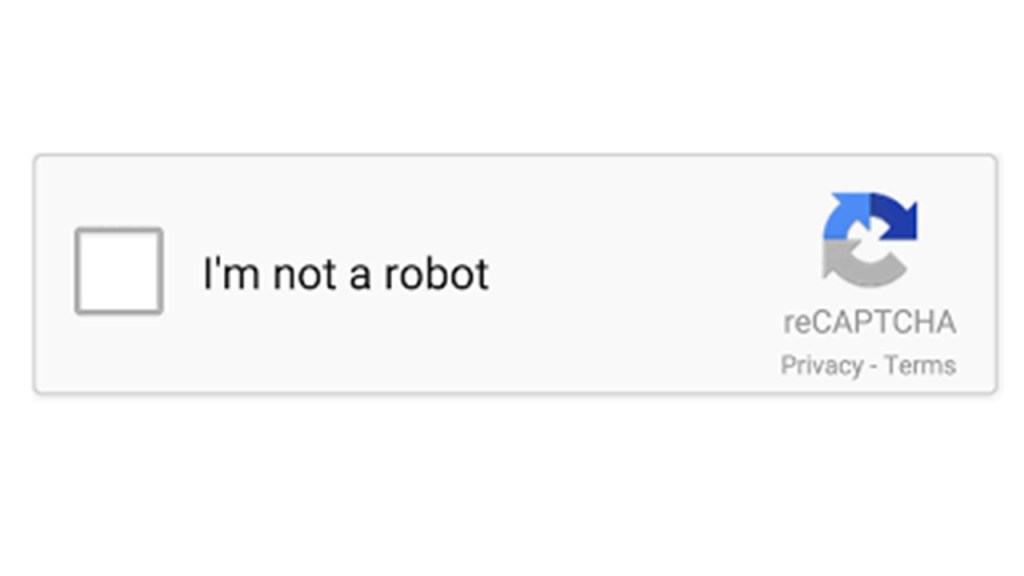
Although the task is simple—move the mouse to the box and click—try as you might, it is nearly impossible to move the cursor in an uninterrupted, flawless motion. You will undoubtedly move it too far to the left or too far up and will have to readjust accordingly. This imperfect motion is benefiting your case that you are in fact a human, as a bot will—within a fraction of a second—calculate an exact move in a pin-straight line, then glide the cursor at a constant speed towards its target.
Thus the question “can you prove you are not a bot?” is answered not by clicking a checkbox, but by demonstrating processing time, hesitation, second-guessing—characteristics not currently imprinted onto Artificial Intelligence. Over the years, we humans might have given our creations incisors and eyelids and the quirkiness to backflip off a platform. We might have created AI in our own likeness, as all gods do, and have taught it to mimic our artwork and our modes of storytelling, but we did not give it the very thing that makes us human—a soul.
If you enjoyed this article, and want to learn more, check out some of the media listed below.
Films with nonhumanoid AI
Transcendence (2014)
Her (2013)
The Matrix (1999, etc.)
2021: A Space Odyssey (1968)
Films/TV with humanoid AI
M3gan (2022)
Ex Machina (2014)
The Terminator (1984, etc.)
Westworld (film 1973; TV Series 2016-2022)
Films created by/with AI
Last Stand (2023)
The Safe Zone (2022)
Sunspring (2016)
For Further Reading
CNN. “Journalist had a creepy encounter with new tech that left him unable to sleep.” YouTube. 17 February 2023. https://www.youtube.com/watch?v=f24JL0nnhcA
Kleinman, Zoe and Chris Vallace. “AI ‘godfather’ Geoffrey Hinton warns of dangers as he quits Google.” BBC News. 2 May 2023. https://www.bbc.com/news/world-us-canada-65452940
Roose, Kevin. “An A.I.-Generated Picture Won an Art Prize. Artists Aren’t Happy.” The New York Times. 2 September 2022. https://www.nytimes.com/2022/09/02/technology/ai-artificial-intelligence-artists.html
Washington Post Staff. “The new Bing told our reporter it ‘can feel or think things.’” Washington Post. 18 February 2023. https://www.washingtonpost.com/technology/2023/02/16/microsoft-bing-ai-chat-interview/
 Joshua Bangera Young
Interesting article
LikeLike